

Legal Risks Every Company in Jakarta Should Avoid
Legal Risks Every Company in Jakarta Should Avoid
Legal Risks Every Company operating in Jakarta should identify and manage before pursuing aggressive business growth. Many companies invest significant resources into expanding their market, increasing revenue, and attracting investors, yet overlook the legal issues that can quietly threaten those achievements. In practice, legal disputes rarely begin with dramatic conflicts. They often start with overlooked contracts, undocumented corporate decisions, or compliance issues that seem insignificant until they develop into costly problems. This is why partnering with an experienced Law Firm is not simply about resolving disputes. It is about preventing them before they affect the business.
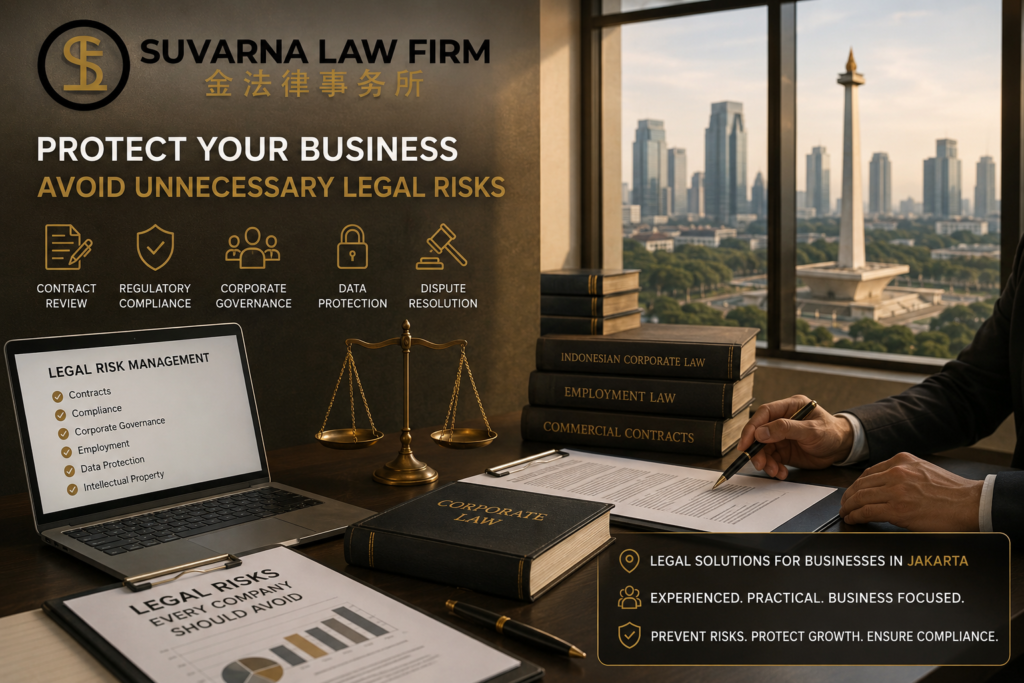
Jakarta is the commercial heart of Indonesia, attracting local entrepreneurs, multinational corporations, technology startups, manufacturers, and investors from around the world. This dynamic business environment creates enormous opportunities, but it also increases legal exposure. Every new business relationship, commercial agreement, hiring decision, or investment transaction introduces legal responsibilities that require careful attention.
Many business owners only seek legal assistance after receiving a warning letter, facing a regulatory investigation, or becoming involved in litigation. From practical experience, companies that take this reactive approach often spend considerably more time, money, and management resources than businesses that prioritize preventive legal strategies from the beginning.
A proactive legal approach allows management to make decisions with greater confidence. Instead of constantly reacting to unexpected legal challenges, executives can focus on business development while knowing that potential risks have been identified, evaluated, and managed appropriately.
Why Businesses in Jakarta Face Increasing Legal Risks
Business regulations in Indonesia continue to evolve alongside economic development. Companies operating in Jakarta must comply with corporate regulations, employment laws, tax obligations, licensing requirements, personal data protection rules, intellectual property regulations, and numerous industry specific requirements.
For many businesses, compliance becomes more complicated as operations expand. Opening additional branches, hiring more employees, entering strategic partnerships, acquiring competitors, or attracting foreign investment all introduce new legal obligations that require careful planning.
One common misconception is that legal risks only affect large corporations. In reality, startups, small businesses, and medium sized enterprises often face similar legal challenges, although their financial capacity to absorb those risks is usually much lower.
From a practical perspective, many disputes could have been avoided through proper legal planning. A contract reviewed before signing, a shareholder agreement prepared during the company’s early stages, or a compliance audit performed before business expansion can prevent disputes that later cost millions of rupiah to resolve.
Understanding Legal Risks Every Company should avoid is therefore an essential part of sustainable business management rather than an optional administrative exercise.
The Real Cost of Ignoring Legal Risks
Business owners often evaluate investments based on immediate financial returns. Legal risk management, however, produces value by preventing losses that may never become visible because the underlying problems were resolved before they escalated.
When companies ignore legal compliance, the consequences extend beyond financial penalties. Management attention shifts away from business growth toward dispute resolution. Customer confidence declines. Business partners become hesitant to continue cooperation. Investors begin questioning the company’s governance practices.
These indirect consequences frequently exceed the direct legal costs associated with a dispute.
Consider a company preparing for a significant investment round. During the investor’s due diligence process, lawyers discover incomplete corporate documentation, unresolved shareholder approvals, and inconsistencies within previous commercial agreements. Although none of these issues has resulted in litigation, the investor may delay or even cancel the transaction until every legal concern has been addressed.
In this situation, the company has not only incurred additional legal expenses but also lost valuable business opportunities.
Working with an experienced Law Firm before entering important transactions allows businesses to identify these weaknesses early and correct them before they become obstacles.
The Most Common Legal Risks Every Company Should Recognize
Although every industry presents unique challenges, certain legal risks repeatedly appear across businesses operating in Jakarta. These issues affect companies of all sizes and frequently become the foundation of larger disputes.
Poorly Drafted Commercial Agreements
Commercial contracts govern relationships with customers, suppliers, distributors, contractors, investors, and strategic partners. Despite their importance, many businesses continue using outdated contract templates without adapting them to each transaction.
Generic agreements often fail to define payment obligations clearly, establish performance standards, allocate business risks appropriately, or determine effective dispute resolution procedures.
From practical legal experience, many commercial disputes arise not because either party intended to breach the agreement, but because the contract failed to anticipate foreseeable business situations.
Professional contract drafting provides clarity for both parties while reducing misunderstandings that may later result in expensive litigation.
Businesses that regularly update their agreements with assistance from a qualified Law Firm are generally better protected when commercial relationships become more complex.
Weak Corporate Governance
Corporate governance is often viewed as a concern only for publicly listed companies. In reality, private companies benefit equally from clear governance structures.
Many privately owned businesses continue making important corporate decisions informally. Directors approve significant transactions through messaging applications. Shareholders discuss strategic matters without documenting resolutions. Company records remain incomplete for years.
While these informal practices may appear efficient during periods of business stability, they create substantial legal uncertainty whenever disagreements emerge between shareholders, investors, or directors.
Incomplete documentation frequently complicates mergers, acquisitions, investment transactions, financing arrangements, and regulatory reviews.
One of the most practical ways to reduce Legal Risks Every Company faces is to establish consistent corporate governance procedures from the beginning, regardless of company size.
Employment Related Disputes
Employment issues remain among the most common sources of litigation involving businesses in Jakarta.
Many disputes begin with relatively simple issues such as unclear employment agreements, inconsistent disciplinary procedures, overtime calculations, employee benefits, confidentiality obligations, or termination processes.
Employers often believe that verbal agreements or long standing internal practices are sufficient. Unfortunately, employment regulations require much more than informal understanding between management and employees.
Proper employment documentation helps protect both employers and employees by establishing clear expectations and reducing uncertainty when workplace issues arise.
Companies that periodically review employment policies with an experienced Law Firm are generally better positioned to adapt to regulatory developments while minimizing potential disputes.
Regulatory Compliance Failures
One of the most underestimated Legal Risks Every Company encounters is regulatory noncompliance. Many business owners believe that obtaining the necessary licenses at the beginning of operations is enough to satisfy their legal obligations. In reality, compliance is an ongoing responsibility that evolves as regulations, business activities, and industry standards change.
As companies expand, they may introduce new products, enter additional markets, hire more employees, or collaborate with foreign partners. Each of these developments can trigger new licensing requirements, reporting obligations, or regulatory approvals that management may not immediately recognize.
For example, a manufacturing company that expands its production capacity may require additional environmental approvals. A technology company collecting customer information may need to strengthen its personal data protection practices. A foreign investment transaction may involve corporate approvals and regulatory notifications that were not previously required.
Businesses that fail to monitor these changes often discover compliance gaps during government inspections, investor due diligence, or commercial transactions.
An experienced Law Firm helps businesses build compliance systems that identify legal obligations before they become regulatory violations. Rather than reacting to government inquiries, companies can demonstrate that compliance has become part of their daily operations.
Intellectual Property Risks That Are Often Overlooked
Many companies invest heavily in branding, product development, software, marketing campaigns, and digital content without adequately protecting their intellectual property.
A business may spend years building customer recognition only to discover that another party has registered a similar trademark. Likewise, valuable software, creative content, confidential business information, or product designs may become vulnerable if proper legal protection has not been established.
From practical experience, intellectual property disputes frequently arise after a business becomes commercially successful. Once a brand gains market recognition, competitors may attempt to imitate its identity or challenge ownership rights.
Businesses should not assume that simply using a business name automatically provides legal protection. Trademark registration, copyright management, confidentiality agreements, and intellectual property strategies should be developed before disputes occur.
Protecting intellectual property is not only about defending legal rights. It also strengthens the company’s commercial value during investment, acquisition, licensing, and expansion opportunities.
Companies that work closely with a qualified Law Firm often identify valuable intellectual assets that management had not previously considered worthy of protection.
Shareholder Disputes Can Disrupt Business Stability
Shareholder disagreements rarely begin with major conflicts. Most start with small misunderstandings regarding profit distribution, management authority, future investments, or business strategy.
During the early stages of a company, founders often rely on personal trust rather than formal legal documentation. While this approach may appear practical among family members or close business partners, it becomes increasingly risky as the business grows.
Without comprehensive shareholder agreements, disagreements regarding voting rights, ownership transfers, dividend policies, or exit mechanisms can quickly escalate into legal disputes that disrupt daily operations.
One common situation involves investors entering a growing company without clearly defining decision making authority. As the business expands, differing expectations regarding management control can create tension between founders and investors.
Another frequent issue arises when one shareholder wishes to sell ownership while others oppose the transaction. Without predefined procedures, negotiations become increasingly difficult and may ultimately require litigation.
Among the many Legal Risks Every Company should address early, shareholder governance remains one of the most important because internal disputes often damage the company more severely than external competition.
Data Protection Has Become a Business Priority
Digital transformation has fundamentally changed the way businesses operate in Jakarta. Companies now collect customer information through websites, mobile applications, online payment systems, loyalty programs, and digital marketing platforms.
While this information creates valuable business opportunities, it also increases legal responsibilities regarding personal data protection.
Many businesses continue collecting customer information without fully understanding how that data should be stored, processed, shared, or deleted. Others rely on outdated privacy policies that no longer reflect current regulatory expectations.
A single data breach can expose confidential customer information, damage public trust, interrupt business operations, and create regulatory scrutiny.
Businesses should regularly evaluate how personal information flows throughout their organization. This includes reviewing internal access controls, employee responsibilities, third party service providers, cybersecurity practices, and contractual protections.
Working with an experienced Law Firm allows businesses to develop practical data governance frameworks that balance operational efficiency with legal compliance.
Why Preventive Legal Planning Delivers Better Business Outcomes
Many executives view legal services primarily as a response to disputes. However, companies with strong legal foundations consistently demonstrate greater resilience during periods of growth, investment, and market uncertainty.
Preventive legal planning helps management identify weaknesses before they become financial liabilities. Instead of waiting for disputes to arise, businesses can strengthen contracts, improve governance, update compliance procedures, and establish internal policies that reduce operational risk.
From a practical standpoint, preventive legal support often requires significantly fewer resources than defending litigation or resolving regulatory investigations.
Companies that integrate legal review into major business decisions also make faster strategic choices because management already understands the legal implications before negotiations begin.
Ultimately, reducing Legal Risks Every Company faces is not about creating unnecessary bureaucracy. It is about providing business leaders with the confidence to pursue growth opportunities while minimizing avoidable legal exposure.
Practical Experience: How Early Legal Action Prevented Major Business Losses
From practical experience, the companies that manage legal risks most effectively are not necessarily the largest organizations. They are the businesses that recognize legal planning as part of their overall business strategy rather than an emergency response.
One Jakarta based trading company planned to expand its operations by appointing several regional distributors. The management team had already negotiated commercial terms and was prepared to sign multiple distribution agreements.
Before execution, the company requested a legal review of every contract. During the review, several provisions were identified that could have created significant problems. The agreements lacked clear exclusivity clauses, failed to define performance targets, and contained vague termination provisions.
Had those contracts been signed without revision, the company could have faced disputes regarding territorial rights, distributor performance, and contract termination within the first year of expansion.
After revising the agreements, the company established clear business expectations, implemented measurable performance standards, and created practical dispute resolution procedures. As a result, the expansion proceeded smoothly without major contractual conflicts.
This example demonstrates that proactive legal planning often prevents disputes that businesses never realize they have avoided.
Another company preparing to receive external investment experienced a similar situation. During internal legal preparation, advisors discovered incomplete shareholder documentation dating back several years. Board resolutions, share transfer records, and corporate approvals were inconsistent.
Rather than allowing these issues to delay the investment process, the company completed a comprehensive legal review, corrected its corporate records, and updated governance documentation before investors began due diligence.
Because these issues were resolved early, the investment proceeded according to schedule, strengthening investor confidence in the company’s management practices.
These examples reflect a common reality. Most significant legal disputes begin with relatively small administrative issues that remain unresolved for years.
Practical Insights From Experienced Legal Professionals
Businesses often ask which legal issues deserve immediate attention. While every company operates differently, several practical priorities consistently provide the greatest long term protection.
First, review every significant commercial agreement before signing. A well drafted contract is considerably less expensive than resolving a contractual dispute through litigation.
Second, maintain accurate corporate records. Board resolutions, shareholder decisions, annual documentation, and regulatory filings should always reflect the company’s actual activities.
Third, conduct periodic compliance reviews. Regulations evolve continuously, and internal policies that were appropriate several years ago may no longer satisfy current legal requirements.
Fourth, educate management teams about legal responsibilities. Many legal problems arise because operational managers make commercial decisions without understanding the associated legal implications.
Finally, seek legal advice before major business events rather than afterward. Business expansion, acquisitions, restructuring, foreign investment, significant employment decisions, and strategic partnerships all benefit from early legal involvement.
Companies that consistently apply these practices significantly reduce Legal Risks Every Company encounters throughout its business lifecycle.
Frequently Asked Questions
What are the biggest legal risks every company should prioritize?
The most common legal risks include poorly drafted contracts, regulatory noncompliance, employment disputes, shareholder conflicts, intellectual property issues, data protection obligations, and inadequate corporate governance. Addressing these areas proactively helps businesses reduce both financial and operational risks.
Why should a company work with a Law Firm before legal problems occur?
An experienced Law Firm focuses on preventing disputes rather than simply resolving them. Early legal advice helps businesses identify weaknesses in contracts, governance, compliance procedures, and commercial transactions before they develop into expensive legal issues.
How often should a company conduct a legal compliance review?
Most businesses benefit from conducting a legal review at least once each year. Additional reviews should be considered whenever the company expands operations, introduces new products or services, receives investment, restructures its organization, or enters significant commercial transactions.
Can small businesses face the same legal risks as large corporations?
Yes. Smaller businesses often encounter the same categories of legal risks, including contract disputes, employment issues, licensing requirements, and shareholder disagreements. The difference is that smaller companies generally have fewer financial resources to absorb the consequences of legal disputes.
How can preventive legal planning improve business growth?
Preventive legal planning allows management to make informed decisions with greater confidence. Strong contracts, effective governance, regulatory compliance, and well managed legal documentation improve operational stability while increasing investor, lender, and business partner confidence.
Conclusion
Every successful business accepts commercial risks in pursuit of growth. However, avoidable legal risks should never become barriers to long term success.
Understanding Legal Risks Every Company should manage is no longer optional in Jakarta’s increasingly competitive business environment. Companies that invest in preventive legal strategies consistently place themselves in a stronger position to protect assets, maintain regulatory compliance, strengthen commercial relationships, and support sustainable expansion.
Legal protection is not measured by the number of disputes a business wins. It is measured by the number of disputes that never occur because proper legal planning was implemented from the beginning.
Protect Your Business Before Legal Problems Escalate
Whether you are establishing a new company, negotiating commercial agreements, preparing for investment, managing regulatory compliance, or resolving complex corporate issues, working with an experienced Law Firm can help your business reduce unnecessary legal exposure.
Our legal team in Jakarta provides practical corporate legal solutions tailored to the needs of domestic and international businesses. From contract drafting and legal due diligence to shareholder agreements, regulatory compliance, and ongoing corporate advisory services, we help companies make informed decisions with greater confidence.
Contact our team today to discuss your business objectives and learn how proactive legal support can strengthen your company’s long term success. You can also find our office location on Google Maps to plan your visit and speak directly with our legal professionals.