

Legal Due Diligence Services for Business Transactions in Indonesia
Legal Due Diligence is one of the most important steps before acquiring a company, investing in a business, entering a joint venture, or completing any major commercial transaction in Jakarta. Many investors and business owners only discover hidden legal risks after signing agreements, resulting in unexpected liabilities, regulatory sanctions, or expensive disputes that could have been avoided with a thorough legal review.
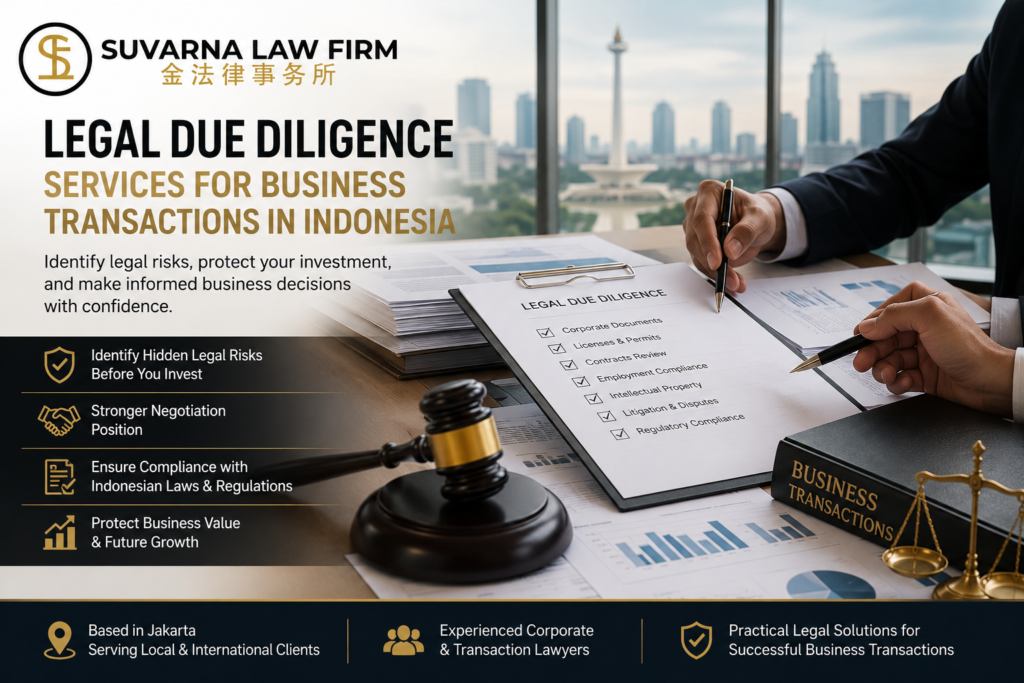
Whether you are an international investor entering the Indonesian market or a local company planning strategic expansion, professional legal due diligence provides the confidence needed to make informed decisions. Instead of relying solely on financial reports or management representations, experienced legal professionals verify whether a business complies with Indonesian regulations, owns its assets legitimately, and has fulfilled its contractual obligations.
This guide explains how Legal Due Diligence works in Indonesia, what it covers, common legal risks uncovered during the process, and why choosing an experienced law firm in Jakarta can significantly reduce transaction risks.
Why Legal Due Diligence Matters Before Any Business Transaction
Many business transactions appear straightforward at first glance. Financial statements may look healthy, revenue may be increasing, and management presentations can be convincing. However, experienced legal practitioners often discover issues that are not immediately visible during commercial negotiations.
These issues commonly include expired licenses, unresolved litigation, invalid contracts, undisclosed shareholder disputes, employment compliance problems, or improperly registered intellectual property. Any one of these problems can reduce the value of a transaction or even prevent it from proceeding.
Conducting Legal Due Diligence before signing definitive agreements allows buyers and investors to identify these risks early. Rather than reacting after closing, parties can renegotiate purchase prices, request corrective actions, include stronger contractual protections, or decide not to proceed with the transaction.
For businesses operating in Jakarta, where regulatory requirements continue to evolve, legal verification has become an essential part of responsible corporate decision making.
What Is Legal Due Diligence in Practical Business Terms?
Unlike generic explanations that define legal due diligence as simply “reviewing legal documents,” experienced practitioners understand that the process is much broader.
Legal Due Diligence is a systematic legal investigation designed to verify whether a company has legal issues that may affect ownership, operations, compliance, profitability, or future growth.
The objective is not merely collecting documents. Instead, legal professionals evaluate whether those documents accurately reflect the company’s legal position and whether hidden risks exist.
A professional review normally answers questions such as:
- Does the company legally exist under Indonesian law?
- Are all corporate approvals properly documented?
- Who actually owns the shares?
- Are business licenses still valid?
- Are important contracts enforceable?
- Is there ongoing litigation?
- Are employees managed according to labor regulations?
- Does the company own its intellectual property?
- Are there tax or regulatory investigations?
- Could any legal issue affect the value of the transaction?
These findings allow investors to understand risks before committing substantial capital.
Business Transactions That Require Legal Due Diligence
Although mergers and acquisitions are the most common situations, Legal Due Diligence is valuable in many commercial transactions.
Acquisition of Private Companies
Acquiring an Indonesian company without verifying its legal status can expose buyers to inherited liabilities.
Professional legal review identifies hidden obligations before ownership changes hands.
Foreign Direct Investment
Foreign investors entering Indonesia often need confirmation that investment structures comply with applicable regulations.
This includes reviewing corporate ownership, investment licenses, foreign ownership limitations, and compliance with sector specific regulations.
Joint Ventures
Joint ventures involve long term cooperation between multiple shareholders.
Legal Due Diligence helps confirm that each party has authority to enter the arrangement and that contributed assets are legally owned.
Business Expansion
Companies planning expansion through strategic partnerships frequently conduct legal reviews to assess potential partners.
This reduces the possibility of partnering with businesses facing regulatory investigations or contractual disputes.
Asset Purchases
When purchasing land, factories, machinery, trademarks, or intellectual property, legal verification confirms ownership and identifies encumbrances that could affect future use.
What Documents Are Reviewed During Legal Due Diligence?
Every transaction is different. However, experienced legal teams generally review a comprehensive range of corporate documents.
Corporate Documents
Corporate records establish the legal foundation of the company.
Typical documents include:
- Articles of Association
- Amendments approved by authorities
- Shareholder resolutions
- Board resolutions
- Share registers
- Company organizational structure
These documents verify whether corporate decisions were properly authorized.
Business Licenses and Regulatory Compliance
Regulatory compliance is particularly important in Indonesia because operating licenses vary across industries.
Lawyers typically review:
- Business Identification Number
- Operational licenses
- Industry specific permits
- Environmental approvals
- Import and export permits
- Investment registrations
Missing or expired licenses may significantly affect business operations.
Material Commercial Agreements
Commercial contracts often determine future business value.
The legal review usually covers:
- Customer agreements
- Supplier contracts
- Distribution agreements
- Loan agreements
- Financing arrangements
- Lease agreements
- Service contracts
- Partnership agreements
Lawyers assess termination rights, penalties, exclusivity clauses, assignment restrictions, and change of control provisions.
Reviewing Employment Compliance
Employment disputes frequently become unexpected liabilities after acquisitions.
Professional Legal Due Diligence includes reviewing:
- Employment contracts
- Company regulations
- Collective labor agreements
- Executive employment arrangements
- Employee benefits
- Social security compliance
- Termination records
Potential noncompliance may create significant financial exposure after closing.
Intellectual Property Verification
Many growing companies derive substantial value from intangible assets.
Legal professionals verify ownership of:
- Trademarks
- Copyrights
- Patents
- Domain names
- Software licenses
- Confidential information
- Technology agreements
Proper ownership documentation protects future commercial use and licensing opportunities.
Litigation and Dispute Assessment
One overlooked lawsuit can dramatically change a company’s valuation.
Experienced lawyers investigate:
- Pending litigation
- Arbitration proceedings
- Government investigations
- Administrative sanctions
- Consumer claims
- Contract disputes
- Debt collection proceedings
Understanding ongoing disputes allows buyers to evaluate financial exposure before completing the transaction.
Tax and Regulatory Considerations
Although tax specialists usually conduct separate financial reviews, legal professionals coordinate with financial advisors to identify legal issues related to taxation and regulatory compliance.
These may include outstanding government obligations, licensing violations, reporting deficiencies, or administrative sanctions that could affect future operations.
Common Legal Risks Discovered During Legal Due Diligence
Based on practical experience assisting business transactions in Jakarta, several recurring issues appear during legal reviews.
One common finding involves incomplete corporate approvals. Share transfers, director appointments, or capital increases may have occurred without proper shareholder resolutions.
Another frequent issue concerns contracts signed by individuals without sufficient authority, creating uncertainty regarding enforceability.
Businesses also occasionally operate under expired operational permits without realizing renewal requirements have changed.
Intellectual property ownership presents another challenge. Companies sometimes use trademarks registered under founders rather than the company itself, creating ownership disputes during acquisitions.
Employment documentation can also reveal inconsistencies, particularly where executive arrangements differ from standard company policies.
Finally, pending disputes with suppliers, customers, or former employees may not appear in financial statements but still represent significant legal exposure.
Each of these findings can influence negotiations, purchase price adjustments, representations and warranties, indemnity provisions, or even the decision to terminate negotiations altogether.
Benefits of Professional Legal Due Diligence Services
Choosing experienced Legal Due Diligence services is not simply about complying with transaction requirements. It is about making better business decisions based on verified legal facts rather than assumptions.
An experienced legal team evaluates both obvious and hidden legal issues, allowing clients to negotiate from a position of strength. The investment made in Legal Due Diligence is often significantly lower than the potential losses caused by undiscovered liabilities.
Better Risk Management
Every business transaction involves some level of risk. The objective is not to eliminate all risks but to understand them before committing to the deal.
Professional Legal Due Diligence helps identify:
- Corporate governance issues
- Regulatory compliance risks
- Contractual liabilities
- Employment obligations
- Pending legal disputes
- Intellectual property concerns
- Licensing deficiencies
Once these risks are identified, buyers can determine whether they are acceptable or require corrective action before closing.
Stronger Negotiation Position
Many buyers assume the agreed purchase price accurately reflects the company’s value. In reality, legal findings often influence valuation.
For example, if Legal Due Diligence reveals unresolved litigation or invalid commercial contracts, buyers may negotiate:
- Purchase price reductions
- Escrow arrangements
- Additional warranties
- Seller indemnities
- Conditions precedent before closing
Without proper legal review, these negotiation opportunities may never arise.
Greater Confidence for Investors
Investors want certainty before committing capital.
Professional legal reports provide decision makers with verified information regarding ownership, compliance, contractual obligations, and legal exposure.
This transparency improves confidence among:
- Private equity firms
- Venture capital investors
- Foreign investors
- Strategic corporate buyers
- Financial institutions
For cross border transactions involving Indonesian companies, comprehensive Legal Due Diligence also demonstrates that legal risks have been carefully assessed before investment approval.
The Legal Due Diligence Process Used by Experienced Law Firms
While every transaction differs, experienced law firms generally follow a structured process to ensure no critical issues are overlooked.
Initial Risk Assessment
The first stage involves understanding the transaction itself.
Lawyers discuss:
- Transaction objectives
- Industry sector
- Business activities
- Corporate structure
- Timeline
- Regulatory requirements
This allows the legal team to tailor the scope of Legal Due Diligence rather than applying a generic checklist.
Document Collection
The target company provides corporate and operational documents requested by the legal team.
Typical categories include:
- Corporate records
- Commercial agreements
- Licenses
- Employment documentation
- Litigation records
- Asset ownership documents
- Intellectual property registrations
- Financing agreements
An organized document request helps speed up the review process while reducing unnecessary delays.
Legal Review and Verification
This stage goes beyond reading documents.
Experienced lawyers compare documents against Indonesian legal requirements, identify inconsistencies, and verify whether the company’s practices align with applicable regulations.
Where necessary, additional clarification or supporting documentation is requested.
The review focuses on practical legal risks that could affect the transaction rather than simply listing technical observations.
Risk Analysis
Not every issue has the same level of importance.
Professional Legal Due Diligence categorizes findings based on their impact.
For example:
High Risk
- Invalid ownership structure
- Major litigation
- Missing operational licenses
- Significant regulatory violations
Medium Risk
- Contract amendments required
- Minor governance issues
- Employment documentation gaps
Low Risk
- Administrative inconsistencies
- Routine filing updates
- Documentation improvements
This prioritization allows clients to focus on issues that genuinely affect transaction value.
Due Diligence Report
The final report summarizes findings in a clear and practical format.
Rather than overwhelming clients with legal terminology, experienced lawyers explain:
- Identified risks
- Commercial implications
- Recommended corrective actions
- Transaction impact
- Suggested contractual protections
Decision makers can then proceed with confidence using reliable legal information.
Practical Experience from Business Transactions in Jakarta
In practice, many legal issues only become visible after a structured review.
One transaction involved a manufacturing company seeking investment from an overseas buyer.
Financial performance appeared strong, and negotiations progressed quickly.
However, during Legal Due Diligence, lawyers discovered that one of the company’s largest production facilities operated under permits that required renewal before the transaction closed.
Had the investment proceeded without addressing this issue, the buyer could have faced operational interruptions and regulatory complications shortly after acquisition.
Because the issue was identified early, both parties agreed that the seller would complete the necessary regulatory updates before closing.
The transaction proceeded successfully without unexpected legal disputes.
In another case, a technology company claimed ownership of several valuable software products.
The legal review revealed that the intellectual property had been created by independent contractors without proper assignment agreements.
As a result, ownership rights were unclear.
Instead of abandoning the transaction, the parties negotiated additional documentation to transfer ownership before completion.
This protected the buyer while preserving the commercial value of the deal.
These examples demonstrate why experienced Legal Due Diligence focuses on practical business outcomes rather than theoretical legal analysis.
Practical Tips Before Starting Legal Due Diligence
Businesses can make the due diligence process more efficient by preparing early.
Organize Corporate Records
Ensure shareholder resolutions, board approvals, and constitutional documents are complete and up to date.
Missing documentation often causes unnecessary delays.
Review Business Licenses
Verify that operational licenses remain valid and accurately reflect current business activities.
Renew expired permits before entering formal negotiations whenever possible.
Prepare Commercial Agreements
Organize important contracts in one secure location.
Include amendments, renewals, and side agreements that may affect legal obligations.
Resolve Outstanding Disputes
Where practical, address unresolved legal disputes before marketing the business for investment or acquisition.
Open litigation may influence valuation and negotiation strategy.
Engage an Experienced Law Firm
Working with an experienced law firm familiar with Indonesian corporate transactions provides valuable insight beyond document review.
Experienced lawyers understand regulatory expectations, common transaction risks, and negotiation strategies that protect clients throughout the process.
Frequently Asked Questions About Legal Due Diligence
How long does Legal Due Diligence usually take?
The timeline depends on the size of the business, document availability, and transaction complexity. Smaller transactions may take a few weeks, while larger corporate acquisitions often require several months.
Is Legal Due Diligence required by Indonesian law?
Not in every transaction. However, it is widely regarded as a best practice because it helps buyers, investors, and lenders understand legal risks before making major commercial decisions.
What is the difference between financial due diligence and Legal Due Diligence?
Financial due diligence focuses on financial performance, accounting records, and tax matters. Legal Due Diligence examines corporate governance, contracts, regulatory compliance, litigation, licenses, employment matters, and legal ownership of assets.
Can Legal Due Diligence identify hidden legal risks?
Yes. One of its primary objectives is to uncover risks that may not be immediately visible through financial reports or management presentations, allowing parties to address those issues before completing the transaction.
Conclusion
Business transactions involve significant financial commitments, and legal issues discovered after closing can become costly and difficult to resolve. Conducting comprehensive Legal Due Diligence before signing definitive agreements allows investors, buyers, and business owners to make informed decisions based on verified legal information.
From reviewing corporate governance and commercial contracts to assessing regulatory compliance, employment obligations, intellectual property, and ongoing disputes, Legal Due Diligence provides a clear picture of the legal health of a business. This process not only reduces risk but also strengthens negotiations, improves transaction certainty, and supports long term business success.
For companies operating in Jakarta and throughout Indonesia, partnering with an experienced law firm ensures that every stage of the due diligence process is handled with careful legal analysis and practical commercial insight.
Protect Your Business Transaction with Professional Legal Support
If you are planning an acquisition, investment, merger, joint venture, or other commercial transaction in Indonesia, obtaining professional Legal Due Diligence services can help you identify legal risks before they become costly problems.
Our experienced law firm in Jakarta assists domestic and international clients with comprehensive due diligence, transaction structuring, regulatory compliance, contract review, and corporate legal advisory services. Contact our team today to discuss your business objectives and learn how professional legal support can help you complete your transaction with greater confidence and reduced legal risk. To schedule an in person consultation, view our Jakarta office on Google Maps and plan your visit with ease.